

Back to Contents
 The most difficult component of PDR and the whole underlying basis to being a PDR technician is being able to locate the exact point of a dent and applying the correct pressure. This is easier than it sounds but mastering this “well guarded secret” takes many months of practice with absolute patience and perseverance!
A few techniques have been developed over the years in order to demonstrate these techniques and how they can be mastered. Of course, once mastered, these techniques specific to the training process will not be required and in the odd case should be avoided – practiced on junk vehicles and not on a client’s vehicle.
Finding the Dent’s exact pressure point
The basic understanding of dent removal can be described as reversing the dents. Assuming that most dents are caused by hailstones that will be repaired by most PDR technicians, what technicians are actually trying to do is reverse the dent’s impact of the hailstone – the perfect scenario is almost like reversing the film of a hailstone impact in slow motion. If only it were the easy.
The pressure point is the dent’s centre of the hailstone impact where obviously the greatest amount of pressure from the hailstone has been applied. This is the point that has to be found to be able to slowly reverse the dent.
There are a few skill prerequisites that are required to be practiced in order to find the centre or pressure point.
- use of florescent lighting
- positioning of the angle combination of the eye and lighting to the dent
- positioning of the hand and in particular the tool to find the exact pressure point
Use of Lights
The use of lights are essential to the PDR process. They help identify not only the number of dents in the process of dent counts and quotation, but also the shape of the dent itself and in particular the location of it centre or pressure point. Furthermore, the lights are used whilst the dent are being repaired discussed in a separate subsequent module.
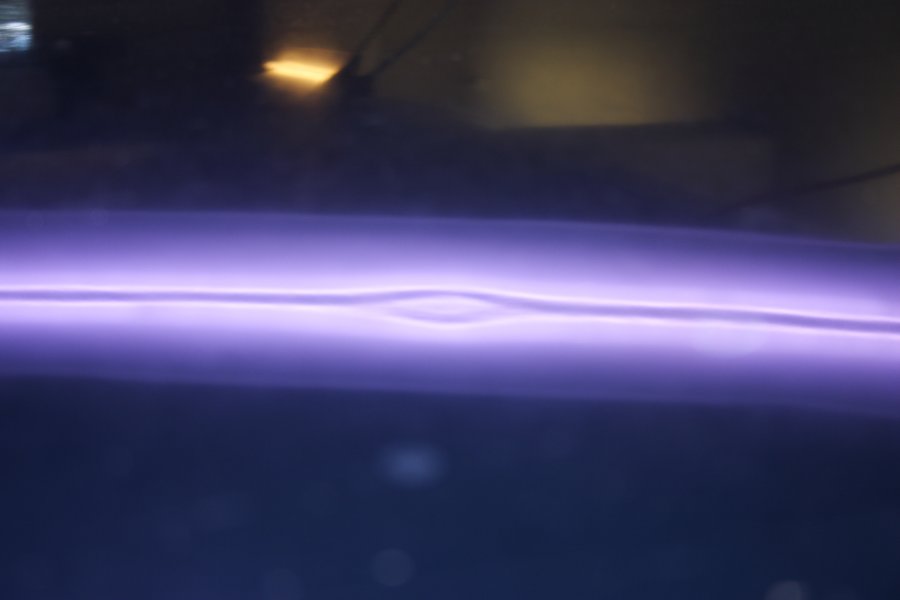
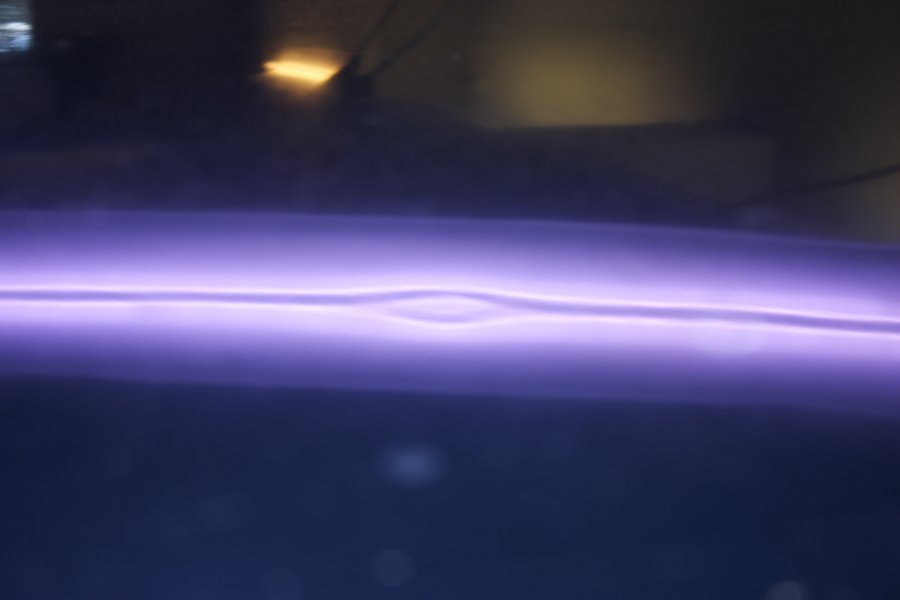
Positioning of the light requires some practice but is not that difficult to accomplish with the average sized dents (ensure the light is a single tube). As you can see in the image, the line of the light is aligned parallel to the panel shape and when positioned correctly in relation to the eye, distortion occurs. Some suggest it is in the shape of an “hour glass” or perhaps a figure “8” as seen in the video. The eye shape as seen in the image may be the first shape observed. Anything that differs as shown in the video after tapping that may look discontinuous means that the alignment of the light is incorrect and should be adjusted to be parallel in order to achieve the “eye” and gradually adjust to an “hour glass” or what I feel looks like a figure 8 shape. Trial and error will eventually see the appropriate reflection perfected.
For smaller shallower dents however, it requires a slightly different angle to form a narrow line that is comparable to the dent. (Remember that sunset creates shadows of smaller objects although not as clear and this is the effect we are trying to achieve for shallower dents). Note the broader reflection is used to show shallower dents. You can see that a faint dark narrow line exists on the windscreen and continues on the roof. It is this narrow dark line that is used as a guide when observing and working on or repairing dents and forming the figure “8”.
Also note, when positioning the light to achieve the figure 8 that you tilt the light itself such that no direct light from the tube is in your eyes and no glare occurs off the vehicle.
Centre of the Dents
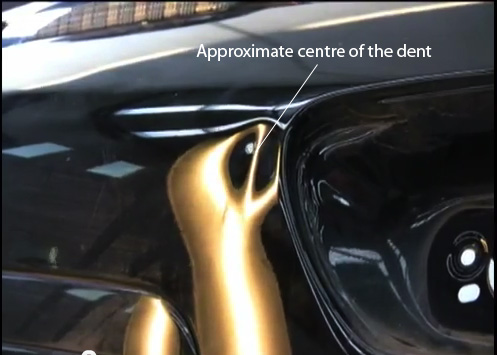 The next piece of the PDR “secret” of PDR is to firstly find the centre of the dent. As suggested above, the hour glass effect is ideal in locating the dent. The middle part of the faint line inside the figure 8 is the centre of the dent. It is where the pressure point will be. Practice is important in perfecting the location of this centre. Adjustment and movement of the light is extremely important in achieving as perfect a figure 8 as possible. Once you achieve a specific standard, you will be in a position to find and work on the pressure point in terms of the repair PDR process. And whilst we are trying to perfect this type of reflection, it is important to be reminded of the earlier quotation process module that the car should be cleaned prior as it will help reveal more dents.
Some innovation in the process of determining the location of the tool tip to assist in finding the pressure point is this use of the A44MRT – Magnetic Roller Tip. Quite a neat tool as suggested in the video for those who are discovering the tool tip location. As can be seen here, the ball bearing follows the strongest part of the magnetic attraction which by design is the magnetic tip – probably due to the close proximity.
